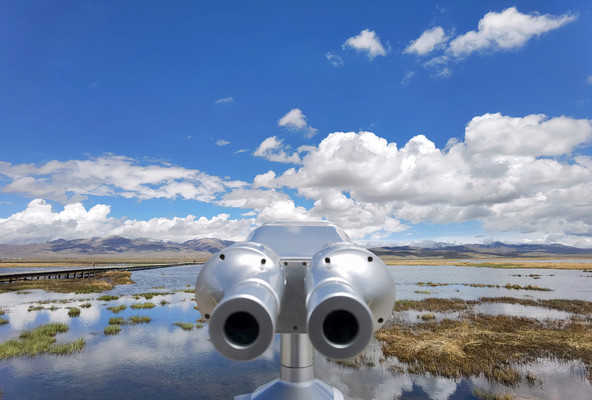
Not every grassland is turned into a check-in spot, but stops when the weather is nice.
Day 1: Zhongchuan Airport - Lanzhou Ink Danxia - Xiahe
Day 2: Labrang Monastery - Sangke Grassland - Luqu
D3: Langmu Temple - Amancang Wetland - Niangma Temple - Jiuzhi County
D4: Lian Baoye - Ruoergai County
D5: Huahu - Zhagana (Fairy Stall)
D6: Zhagana (Viewing Platform) - Mila Lipa Buddha Pavilion - Eighth Lane Thirteen Alleys
D7: Zhongshan Bridge - Zhangye Snack Street - Dazhong Lane - Provincial Museum (Lanzhou One-Day Tour)
Day 1: Zhongchuan Airport - Lanzhou Ink Danxia - Xiahe We dragged our excited and sleepy body onto a flight to Zhongchuan Airport around 7 o'clock. As soon as we landed, we contacted the car rental company to pick up the car, and began our journey to Gannan.
Danxia landform from an airplane perspective~
[Lanzhou Ink Danxia Scenic Area]
It's about 40 kilometers from Zhongchuan Airport, about a 50-minute drive. Arriving at the scenic area around noon, it's hot and sunny (make sure to protect yourself from the sun—ultraviolet rays are very strong here in Gansu). Put on a sun hat and sunglasses in full!!
Lanzhou Ink Danxia Scenic Area is very large. The ticket price is 60 yuan including the sightseeing bus, which feels very reasonable; Although the scenic area is large, the main attraction is to take the sightseeing bus to the site, and the bus goes and returns, which is very friendly for those who don't want to hike. (One thing to note: when riding the sightseeing bus, always wear your seatbelt and don't stick your limbs out of the bus. Be sure to pay attention to safety!!) )
After ticket check, take the bus to the first attraction, the Silk Ancient Road. There will be alpacas, horses, and other small animals here. You can buy some vegetables to feed them. Sisters, listen to me and line up to take the sightseeing bus to the second spot, the Danding Lanjing. It's truly breathtaking and the best viewpoint! There are wooden stairs on both sides. If you're not afraid of fatigue or heights, you can choose to go up. There's an elevator next to the restroom in the middle! You can take it directly to the viewing platform!! (Unfortunately, I didn't see it at the time, and only found out there was an elevator when I got up—I cried). The third and fourth attractions are the Silk Road Glow and Nine-Colored Danxia, where you can see the Danxia landforms from different angles. You'll be amazed by nature's craftsmanship. Each spot has shuttle buses, so you can choose whether to continue down or return depending on your situation. Since there's still over 200 kilometers to go, we only saw the fourth spot and then returned. In short, for those who haven't seen the Danxia landforms, Ink Danxia is also a great choice. It's close to the airport, so you can set aside 3-4 hours to explore when arriving or leaving.
Duration: 3-4 hours
To make it easier to visit Labrang Wat the next day, we stayed directly near the temple. There are many hotels nearby, and the accommodation conditions were quite good throughout the trip. There are plenty of restaurants nearby, making it lively.
Day 2: Labrang Monastery - Sangke Grassland - Luqu [Labrang Monastery]
At around 3000 meters altitude, when I woke up, both my husband and I had some altitude sickness, and my husband felt even worse. Here, I recommend a great all-altitude syndrome product—headache powder. It's especially effective. After finishing one pack, the headache disappears after a while.
Labrang Monastery is one of the most famous Tibetan Buddhist holy sites. Outside the temple stands an extra-long prayer wheel, said to stretch 3 kilometers and take an hour to complete a full circle. Many locals come here to worship.
Outside Labrang Wat is a bustling commercial street with some ethnic-style shawls and small accessories to buy. Next to the parking lot, there's a service center where you can rent Tibetan costumes for photos.
Admission: Labrang Wat 40 RMB per person. If you do not enter the hall, you can visit for free. Gongtang Pagoda is 20 RMB per person, allowing you to climb up and view the entire Labrang Monastery. Parking is 10 RMB per visit.
The back of the ticket lists the tour route (make sure to keep your ticket, as there is ticket verification before entering the hall). You can follow the route and visit on your own. At the visitor center, there are also free guides—monks inside the temple—who will lead tours and guided tours. Since the tour is irregular and the tour is irregular, since we went during the May Day holiday, following the guide wouldn't get inside because there were too many people, so we explored on our own. After visiting the main hall, you can head to the Gongtang Pagoda. Next to the pagoda is a bridge, and from across the bridge you can climb to the highest point to overlook Labrang Wat from the highest vantage point.
Labrang Wat is truly vast, with a strong religious atmosphere. You can see devotees from all over and simple locals praying devoutly, inspiring deep respect.
Practical tips:
(1) Always respect local culture and avoid discussing sensitive religious or political topics carelessly.
(2) Enter the temple and visit clockwise; no hats or sunglasses are required inside the hall.
(3) Dress appropriately; do not wear shorts or short skirts, but may wear long skirts.
Duration: 4 hours for photography + sightseeing
Day 3: Langmu Temple - Amancang Wetland - Niangma Temple - Jiuzhi County [Langmu Temple]
"Exploring the mysterious Tibetan culture and appreciating sacred Buddhist faith—all of this can be perfectly experienced at Langmu Temple."
Langmusi Town sits at an elevation of 3500 meters, located between Luqu County in Gannan, Gansu, and Aba in Sichuan, with the Bailong River running through the town. Langmusi Town has two temples: one in Gansu, called "Dacang Langmusaichi Temple," and the other in Sichuan, called Ge'erdi Temple; Both temples belong to the Gelugpa school of Tibetan Buddhism. Gansu Temple is larger in scale, built along the mountain, with more grand and magnificent buildings, especially sparkling in sunlight; Sichuan Temple mainly attracts the natural scenery—the Namo Grand Canyon.
Langmusi Town really has everything: convenience stores, restaurants (barbecue, Tibetan cuisine, Sichuan cuisine, and they're super popular, so you have to wait for a seat, haha), and pharmacies. You can buy an oxygen tank as a backup. I have to mention that the weather in Luqu is noticeably colder than in Xiahe, so cold I put on my down jacket and it felt like winter had arrived overnight.
Dacang Langmu Saichi Monastery (Gansu Monastery) ticket is 30 yuan per person, parking is 5 yuan per visit. Overall, Saichi Monastery feels more comfortable than Labrang Monastery.
Duration: 1.5 hours
Day 4: Lianbaoyeze - On the highway from Jiuzhi, Ruoergai County to Lianbaoyeze, it's so beautiful~
The mud houses I happened to encounter on the way were quite unique~
[Lianbao Yeze]
Lianbaoye is the southernmost segment of this trip, located in Aba County, Sichuan, with an average elevation of about 4000 meters and the highest point at 4520 meters. From Jiuzhi County to the Lianbaoye Scenic Area is 97 kilometers, with a drive of about 105 minutes. There is a section of road construction along the way, so the road is a bit bumpy, so please pay attention to safety.
Admission: 120 RMB per person. It's expensive but absolutely worth it. It's one of the very few attractions you can drive to the viewing platform. Except for the narrow 1km road to the 4520 viewing platform, the rest of the road conditions are quite good.
There is a route map on the back of the ticket. The final destination is Zhaga'ercuo Sheng Lake. The first half is about driving to view Shitou Mountain from afar, with many stops along the way. I am very grateful to heaven for a clear and beautiful day. It is truly a beauty beyond words. The path is filled with strange peaks, rocks, snow-capped mountains, and lakes—every snapshot turns into a masterpiece. It truly lives up to the saying, "Wherever you go, there is scenery."
What surprised me was that there was a mountaintop café right in the Baengyangpyeong parking lot, where you could buy a hot coffee or fruit tea to rest for a while, then head to the 4520 viewing platform to see the sacred lake at Zhagarcuo. The distance from the entrance to the sacred lake is about twenty kilometers.
Duration: 3-4 hours
Route fragment
7 days
- Arrived in Lanzhou
- Cooperation with surrounding areas
- Grassland Highway
- Stop in the town
- Return trip